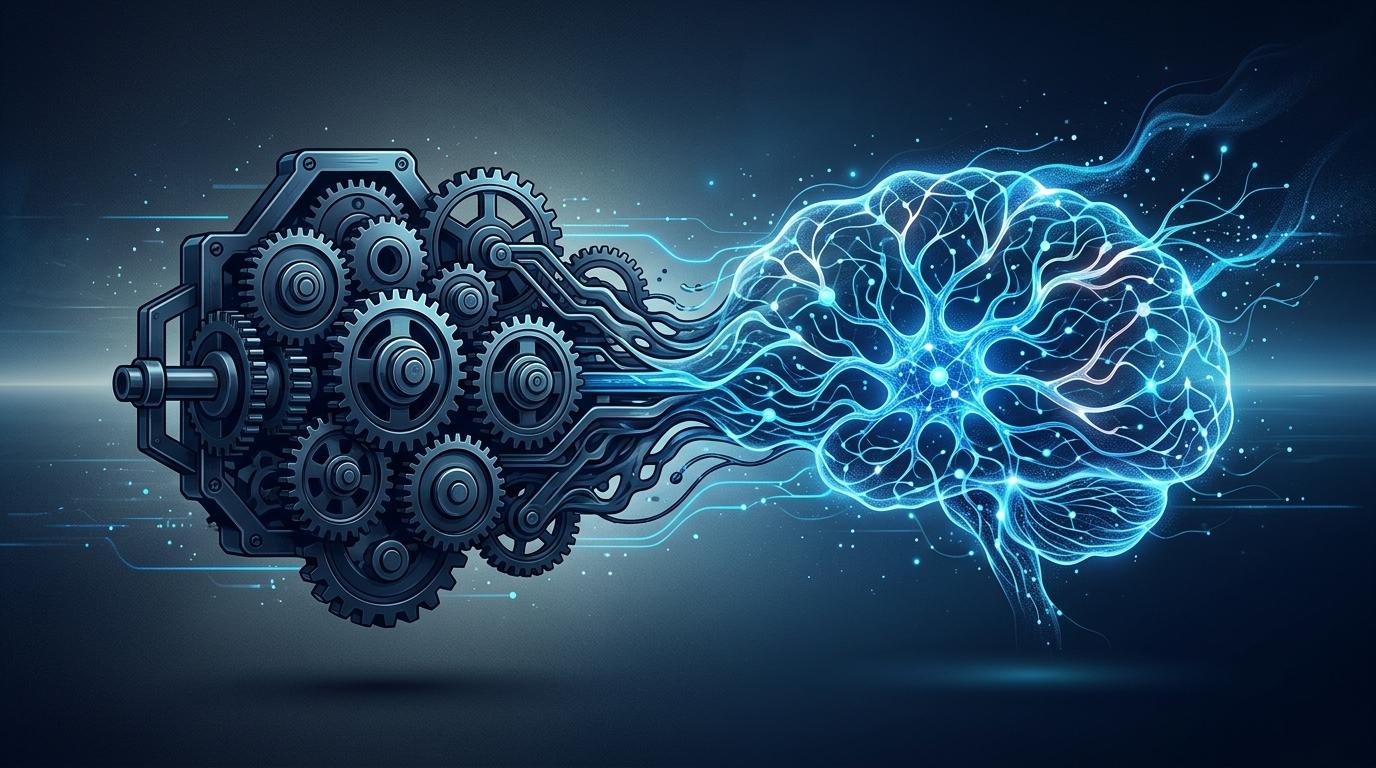
Deep seniority in traditional coding is becoming a barrier to AI innovation. While many veterans use AI merely for boilerplate, non-traditional developers are building agentic systems by rethinking the very nature of software orchestration.
The Invisible Ceiling of Experience
In the landscape of modern software development, we are witnessing a peculiar phenomenon. As AI tools proliferate across the industry, a pattern has emerged that is as uncomfortable as it is undeniable: deep seniority in traditional coding does not equate to AI fluency. In many instances, the most seasoned engineers are the least innovative when it comes to leveraging Large Language Models (LLMs). They are falling into what I call the Expert's Trap.
For over two decades, the engineering mindset has been defined by determinism. We write a rule, we define a logic flow, and the machine follows it with rigid precision. We are masters of syntax, architects of systems that rely on predictability. However, AI is fundamentally probabilistic. It requires a departure from the command-and-control paradigm toward a new philosophy of orchestrating outcomes. If you attempt to force an LLM into the development workflows of 2015, you are simply building a faster version of the past, rather than capturing the exponential potential of the present.
The Boilerplate Paradox
Many senior engineers currently utilise tools like GitHub Copilot as a glorified autocomplete. They use AI to generate boilerplate, write unit tests, or regex patterns. While this offers incremental gains in productivity, it misses the forest for the trees. By treating AI as a faster keyboard, these professionals are tethered to their existing mental models.
Conversely, I have observed product owners, designers, and hobbyists pushing the boundaries of what is possible. Because they are not bound by the dogmas of traditional software architecture, they are not preoccupied with "unit testing" an agent into submission. Instead, they are reimagining workflows and building agentic systems that operate autonomously. They are focused on the outcome rather than the syntax.
Shifting from Control to Orchestration
The transition from deterministic programming to probabilistic orchestration is the greatest challenge facing senior engineers today. In the past, we debugged line by line. With agentic systems, we must debug intent and context. This requires a level of humility that is difficult for those who have spent their careers refining their expertise in specific languages or frameworks.
Consider my work on the Context Aware AI Guidance System. The project was not about writing cleaner functions; it was about designing a system that could interpret user intent across varying degrees of ambiguity. If I had approached this using a 2015 development mindset, I would have spent months building complex decision trees that would inevitably fail under edge cases. Instead, I had to unlearn the desire to control every logic gate and embrace the probabilistic nature of the LLM.
The Future is Humility
Industry experience remains a vital foundation for security, architecture, and system scale. We cannot ignore the necessity of robust data handling or infrastructure management. However, experience is not a free pass on the AI learning curve. The playing field has been levelled. In 2026, the most valuable skill will not be the ability to recall syntax or memorise library documentation.
The most valuable skill is the capacity to become a student again. It is the ability to look at a workflow and ask: "If I were not constrained by the way we have always done this, what could this look like?"
We must move beyond using AI to write code faster and begin using it to build things that were physically impossible to construct yesterday. The Expert's Trap is only a trap if we refuse to acknowledge that the rules of the game have fundamentally changed. To advance, we must be willing to let go of the keyboard and start architecting for ambiguity.