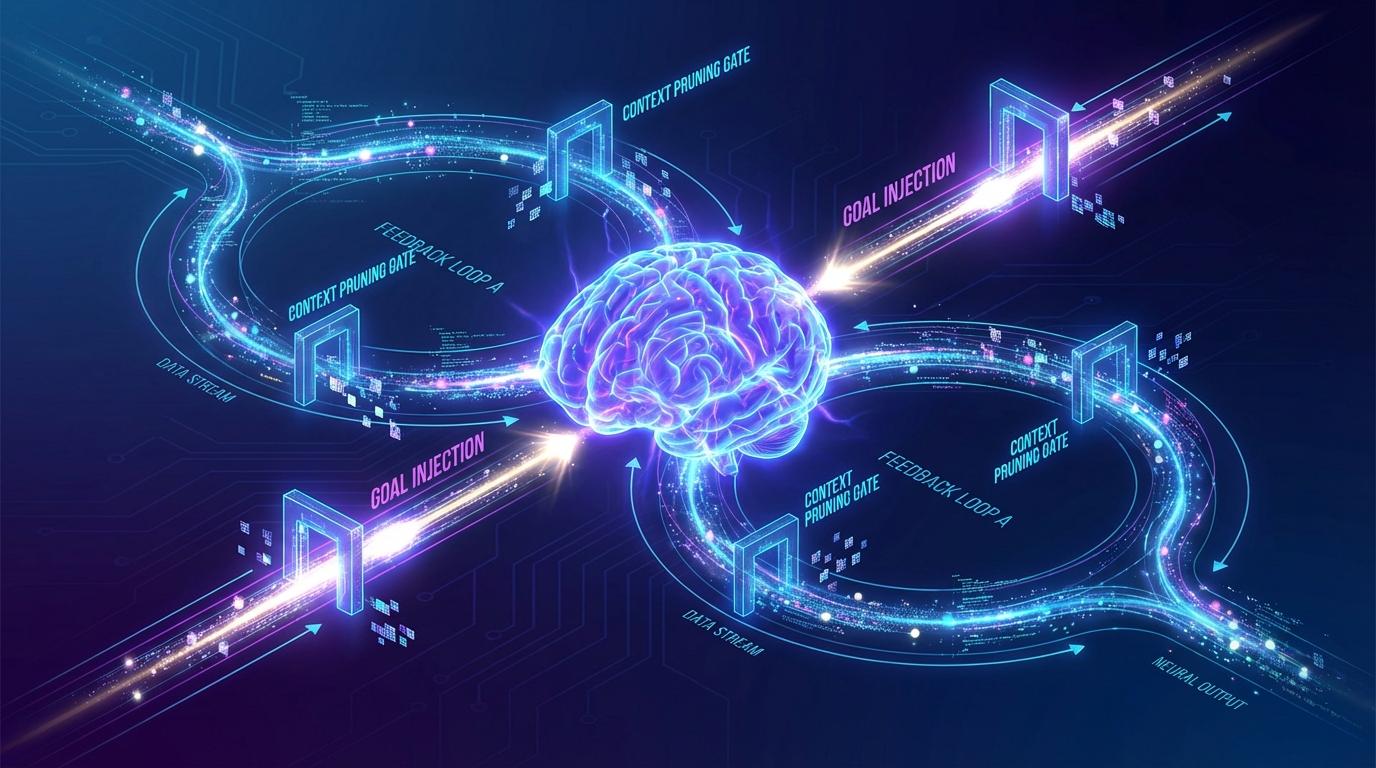
Expanding context windows is a superficial fix for a deeper architectural problem. New research shows that context drift is a manageable stochastic process, requiring active engineering through periodic anchoring and external state management rather than just more memory.
For the past year, the artificial intelligence industry has been locked in an arms race. The prevailing wisdom was simple: if an LLM forgets its instructions during a long task, just throw a larger context window at the problem. We have treated context as a bucket that simply needs to be bigger to hold more information without spilling.
However, recent research into multi-turn LLM interactions (arXiv:2510.07777) suggests we have been treating the wrong symptom. The science reveals that context drift is not an infinite, linear decay where the model slowly loses its mind until nothing remains. Instead, the degradation of instruction adherence stabilises at a measurable, noise-limited equilibrium. Essentially, the model does not just keep forgetting forever; it reaches a state where the signal-to-noise ratio bottoms out.
The Myth of the Infinite Haystack
The assumption that larger context windows lead to better long-horizon performance is a fallacy that ignores how probabilistic transformers actually function. As the context grows, the attention mechanism is forced to spread its weights across an increasingly dense field of tokens. This leads to a phenomenon often called the lost-in-the-middle effect, but the implications go deeper. When we rely on a raw context window to passively manage state, we are essentially asking the model to perform its own noise filtration in real-time.
The research demonstrates that we can actively suppress this drift. We do not need to feed the model massive amounts of history to maintain focus. Instead, the paper proves that injecting lightweight, targeted goal reminders into the interaction loop at specific intervals can reset the drift back to zero. This is a fundamental shift for AI Engineering: we must move from passive context consumption to active context management.
Strategy 1: Periodic Anchoring
One of the most effective ways to combat drift is Periodic Anchoring. This involves dynamically injecting the core system instructions back into the conversation every few turns. By doing this, we mathematically force the model's attention back to the baseline. It is the difference between giving a worker a set of instructions at 9:00 AM and never speaking to them again, versus checking in every hour to remind them of the primary objective. In production-grade systems, this can be automated within your orchestration layer.
Strategy 2: Context Pruning and Summarisation
Rather than letting the conversation history grow indefinitely, which dilutes the semantic signal, we must actively summarise and truncate the noise. In my work on the Context Aware AI Guidance System, I found that maintaining a rolling summary of the user's progress through a multi-lender application was far more effective than passing the entire raw session log. By pruning irrelevant turns and keeping only the salient state changes, the model's performance remained consistent even after thirty or forty interactions.
Context pruning involves identifying which messages are strictly necessary for the current turn. If the user is currently in a billing workflow, the LLM likely does not need the verbatim transcript of the initial greeting from twenty minutes ago. It only needs the current state variables and the immediate history.
Strategy 3: External State Management
Perhaps the most robust solution is to move long-term memory out of the unstructured prompt entirely. By tracking state in a deterministic database, we treat the LLM as a stateless processing unit rather than a memory bank.
By using an external database to store user preferences, progress, and previous decisions, we only feed the LLM the specific variables it needs for the current turn. This reduces the token count, lowers latency, and ensures that the model cannot hallucinate its own history.
The Engineering Perspective
We cannot expect a probabilistic model to maintain perfect alignment over a long time horizon on its own. The physics of the technology work against it. You do not fix an LLM by forcing it to read more text; you fix it by engineering the environment around it to constantly remind it of its purpose. This is the difference between basic prompting and true AI Engineering.
As we build more complex, autonomous agents, the ability to manage drift will become the primary differentiator between hobbyist projects and production-ready infrastructure. We must stop relying on the brute force of context windows and start applying the finesse of active state management. How is your team currently handling state in long-horizon tasks? Are you still building larger haystacks, or are you starting to refine the needle?