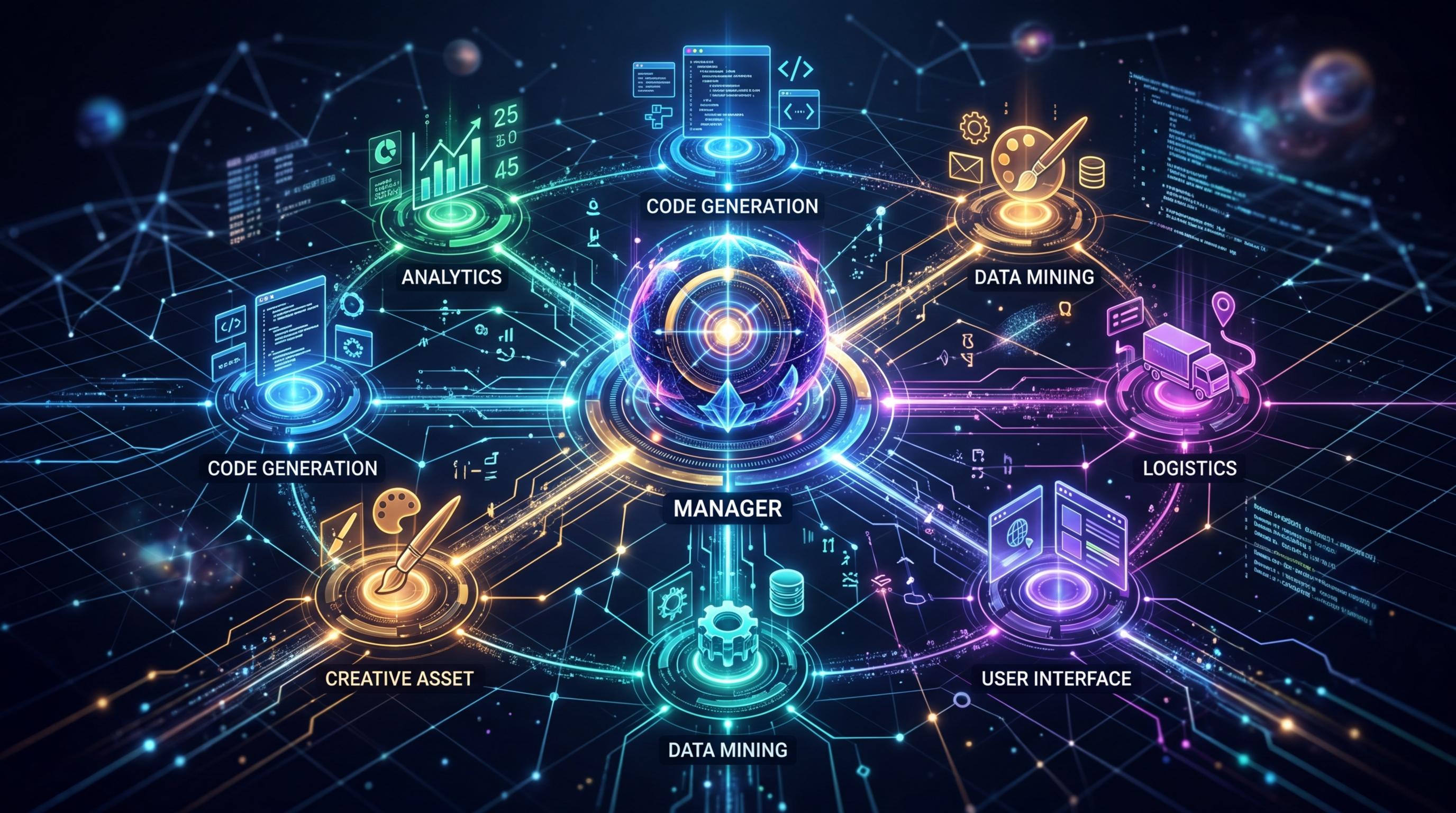
The era of the simple chatbot is over. Discover why the shift to Modular Agentic Frameworks is the most significant architectural change since microservices, and learn the four pillars of building reliable enterprise AI systems.
The novelty of the chatbot has officially evaporated. In boardrooms across the country, the initial excitement of seeing an LLM summarise a document has been replaced by a sobering reality: a chat interface is not a strategy. If your enterprise AI roadmap is still centred on simple Retrieval-Augmented Generation (RAG) and "asking questions to a PDF," you are not building the future. You are building a legacy system.
The Architectural Shift: From Chatbots to Agents
We are currently witnessing the most significant architectural shift in software engineering since the transition from monolithic applications to Microservices. For the last two years, organisations have treated Large Language Models (LLMs) as advanced encyclopaedias. We fed them data, asked them questions, and hoped the hallucinations stayed within acceptable limits.
However, the "Super Agent" model - a single, massive prompt designed to handle every customer query, technical support ticket, and internal data analysis task - is a recipe for failure. These monolithic agents suffer from high latency, frequent hallucinations, and a complete lack of reliability. The winners of the next era are moving away from "chat" and towards Modular Agentic Frameworks.
Pillar 1: Agent Files (The Identity)
An agent that attempts to know everything eventually executes nothing well. The first pillar of a modern system is the use of Agent Files. These are distinct configuration files that define a specific persona, a strict boundary of responsibility, and a curated knowledge base. In my work on the Context Aware AI Guidance System, I found that limiting an agent's scope to a specific lender's criteria significantly improved accuracy compared to a general FinTech assistant.
By defining an agent's identity in a structured format, you ensure that the LLM understands exactly what it is - and more importantly, what it is not. This compartmentalisation is the foundation of system stability.
Pillar 2: Specialised Skills (The Tools)
An agent without tools is just a poet. To move beyond the chatbot era, we must decouple "Thinking" from "Doing." We do this by equipping agents with Specialised Skills. These are atomic, API-driven capabilities that allow the agent to interact with the real world.
Instead of asking an agent to "help a customer with a refund," we provide it with a CalculateRefund skill and a SearchCRM skill. This transforms the AI from a conversationalist into an operator. The following Python snippet demonstrates how we might define these skills within a modular framework:
class FinanceSkills:
    def calculate_refund(self, order_id: str):
        # Logic to interface with the payment gateway
        return f"Refund processed for {order_id}"

class Agent:
    def __init__(self, identity: str, tools: list):
        self.identity = identity
        self.tools = tools

# Defining a specialised agent with atomic skills
refund_agent = Agent(
    identity="Refund Specialist",
    tools=[FinanceSkills().calculate_refund]
)
Pillar 3: Orchestrated Workflows (The Logic)
Linear, sequential flows are a relic of 2023. Enterprise-grade agentic systems require Graph-based Workflows. Unlike a simple chain, a graph allows for loops, conditional branching, and parallel execution. This architectural choice enables three critical capabilities:
- Self-Correction: If a specific skill fails or returns an error, the agent can reroute the task to a different tool or retry with corrected parameters.
- Parallel Execution: Multiple agents can work on separate sub-tasks simultaneously, such as one agent drafting an email while another validates the technical data.
- Human-in-the-Loop: Strategic pauses can be hard-coded into the graph, requiring a human manager to approve a high-stakes action before the system proceeds.
This is exactly the type of logic I implemented for the AI Powered Event Management CMS, where different agents handled team management and result processing in parallel to ensure high performance under load.
Pillar 4: Governance and "The Manager" Agent
When you have a system comprised of 50 or 100 specialised agents, who watches the watchers? This is where the Supervisor Agent comes in. The Manager Agent does not perform technical tasks; its only job is to route tasks to the correct specialised agent and validate that the output meets enterprise compliance standards.
The Supervisor acts as the primary interface for the user, breaking down a complex request into a series of tasks for the "workers." This hierarchical structure prevents the "Super Agent" bloat and ensures that every response is checked against your corporate safety and quality guidelines.
The Hard Truth: Moving Beyond the PoC
Building a Proof of Concept (PoC) is easy. Anyone can hook an API key up to a text box and get a clever response. The real engineering challenge of 2026 is orchestrating a system that does not hallucinate its way out of a job. It requires moving from a mindset of "prompting" to a mindset of "system design."
We are no longer just writing code; we are designing ecosystems of intelligence. This requires rigorous testing, observability, and a modular approach that allows for the hot-swapping of models as newer, faster, or cheaper versions become available.
The question for every CTO and Lead Developer today is simple: Are you still building a chatbot, or are you building a system?