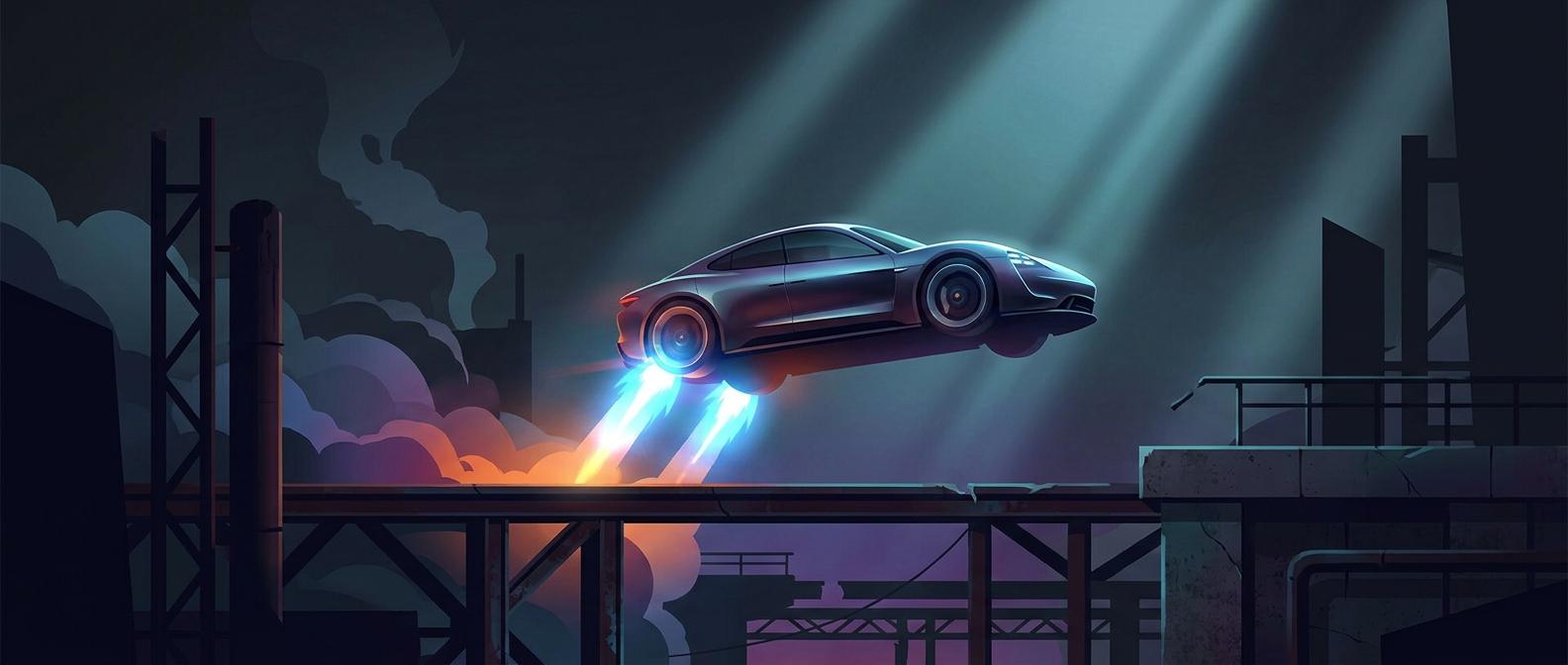
The Tesla Roadster's mid-air kickflip was not just a stunt. It was a calculated signal. Here is why the event in Texas predicts an impending multi-trillion-dollar merger between Tesla and SpaceX.
I usually stick to my regular Friday release schedule, but this news warrants breaking routine. If you watched the Tesla Roadster reveal this week, you saw a sports car use SpaceX cold-gas thrusters to literally launch itself into the air, perform a mid-air barrel roll over a Tesla Semi, and land back on its wheels.
It was an incredible piece of aerospace engineering bolted onto a chassis. It was objectively cool to watch. And, as many commentators have rightfully pointed out, it is an absolute gimmick with virtually zero practical application for a consumer market.
But what I haven't seen commentators point out is what this spectacle actually signals: an impending corporate consolidation. If you view the Roadster kickflip merely as an automotive product feature, you are missing the entire picture. I am calling it now: this event was the strategic pre-briefing for a merger between Tesla and SpaceX.
If you look past the stage in Texas and look at the operational and financial realities happening this exact same week, a much clearer, more pragmatic picture emerges. The Roadster stunt is the narrative bridge designed to condition Wall Street and retail investors for an impending mega-merger.
Here is why the event signals that a consolidation is imminent, what the flying car is trying to distract you from, and what it is really selling.
The Reality: The China Slowdown
While a car was doing backflips in Texas, the core engine of Tesla's actual revenue, its manufacturing base, was quietly hitting a wall.
Over the last few months, the operational reality in China has become increasingly grim. In the first half of 2026, Tesla's China sales fell by roughly 9%, dropping them out of the top ten in the domestic New Energy Vehicle (NEV) market. We are now seeing reports of production pauses and line closures at Giga Shanghai.
The reasons are structural. The domestic Chinese price war is brutal, local competitors are undercutting them, and legacy giants like Toyota are finally bringing massive $2 billion gigacasting plants online in China to close the manufacturing-efficiency gap.
There is also a critical geopolitical dimension. SpaceX is a major US defence contractor subject to strict ITAR regulations. For Tesla and SpaceX to legally complete an all-stock merger, deep technical exposure or operational data links inside China pose a serious national security hurdle. Winding down or closing facilities at Giga Shanghai may double as a legal and regulatory manoeuvre to clear defence clearances in Washington before any consolidation can move forward.
If you are evaluating Tesla strictly as an automaker, the narrative right now is concerning. Their highest-margin factory is facing overcapacity, the Model S and X lines were killed off earlier this year, and their core hardware business is being commoditised by agile Chinese competitors.
If Tesla remains just a car company, its valuation will eventually compress to that of a car company. To prevent that, the narrative has to shift.
The Pitch: The Ultimate AI Conglomerate
This is where SpaceX thrusters burst into the conversation.
For months, quiet speculation has swirled about Elon Musk consolidating his empire. But watching a vehicle powered by cold-gas rocket thrusters land a kickflip turned speculation into an outright prediction for me. Right as the Roadster took flight, Barclays analysts echoed this exact thesis, predicting an all-stock merger between Tesla and SpaceX before the end of the year. I am predicting that this merger will be announced much sooner than Wall Street expects.
The financial and operational mechanics of this are staggering. SpaceX recently absorbed xAI. Tesla is heavily invested in the Optimus robotics platform and autonomous driving. By merging the two, Musk would consolidate his voting control to around 56% of a combined $3.6 trillion mega-corporation.
More importantly, it shifts the entire corporate identity. You are no longer asking investors to buy shares in an automaker losing ground in Shanghai and to Chinese EVs. You are asking them to invest in an unprecedented, unified AI, Robotics, and Aerospace monopoly. You are merging Tesla's Optimus robots and Robotaxis with SpaceX's Terafab compute clusters and xAI's Grok models.
As I explored in my analysis of The LLM Plateau: When the Model Stops Being the Moat, raw software capabilities alone no longer provide a sustainable competitive advantage. The value is shifting toward custom hardware, massive compute infrastructure, and physical execution. Merging these disparate entities creates a closed-loop ecosystem spanning orbital satellite internet, supercomputing hardware, and autonomous robotics on earth.
The Narrative Bridge: Sleight of Hand as Financial Strategy
When you understand that financial context, the Roadster stunt makes perfect sense.
How do you convince sceptical retail investors and institutional shareholders that a car company and a rocket company actually belong on the same balance sheet? You do not just show them a slide deck about shared supply chains and battery revenue.
You take a physical product, bolt SpaceX thrusters onto a Tesla chassis, and launch it into the air in front of millions of people.
The flying Roadster is not a car you are ever going to commute in. It is a multi-million-dollar marketing prop designed to make the integration of Tesla and SpaceX feel physical, tangible, and inevitable. It is the ultimate sleight of hand: making you look up at a flying car, so you do not look down at the stalling factory lines.
In an era where market valuations are driven as much by story as by spreadsheet, this corporate theatre is not accidental; it is essential. By blurring the boundaries between automotive engineering and aerospace physics, the spectacle resets investor expectations. It asks Wall Street to stop valuing Tesla on quarterly vehicle deliveries and start valuing it as an infrastructure pillar of a multi-planetary AI ecosystem. Whether that narrative can sustain a $3.6 trillion valuation in the face of ground-level manufacturing friction remains the ultimate test.