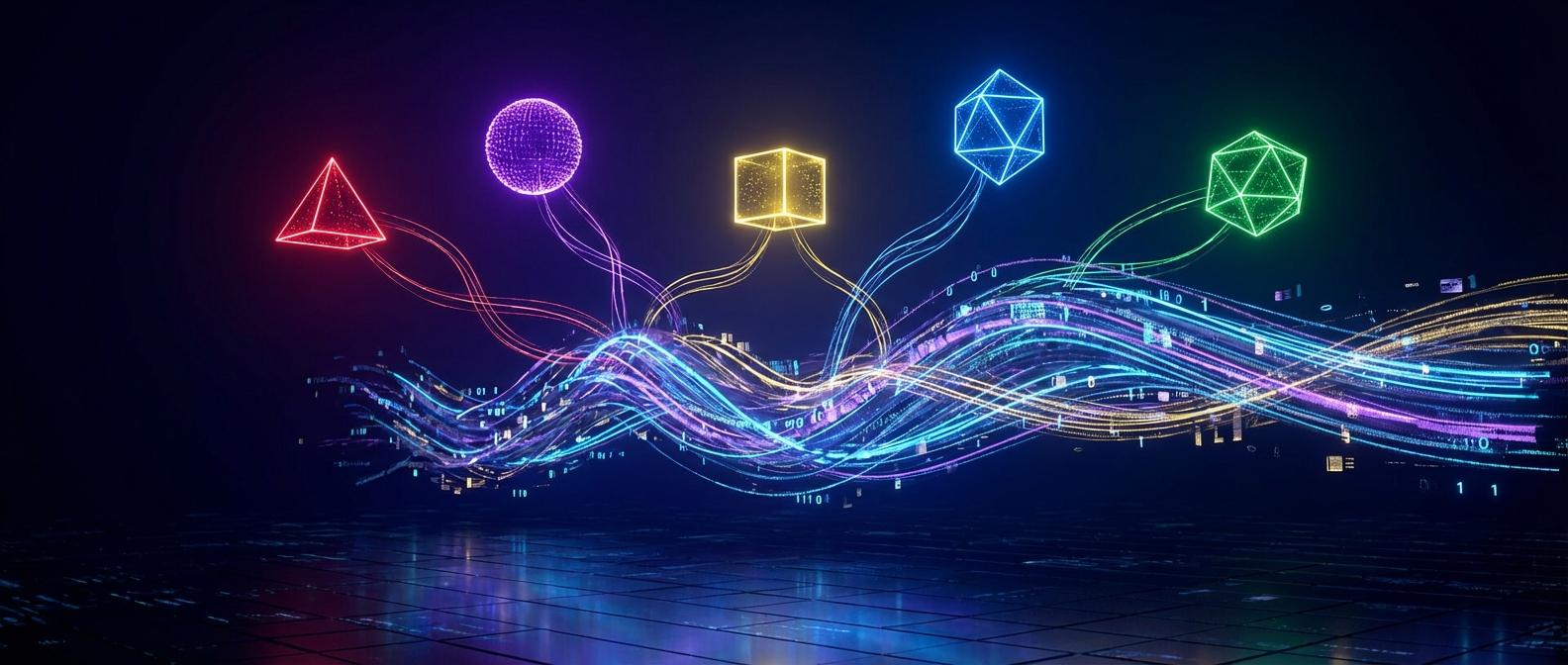
Discover 'The OpenSwarm', a groundbreaking decentralised multi-agent system where coordination emerges from a shared 384-dimensional 'Neural Bus'. Explore how latent collaboration and semantic resonance allow autonomous agents to solve complex tasks without ever speaking to one another.
Introduction: The Connectivity Paradox in Multi-Agent Systems
In the contemporary landscape of Artificial Intelligence, the traditional approach to Multi-Agent Systems (MAS) often hits a ceiling regarding scalability and robustness. Conventional architectures rely heavily on explicit inter-agent communication: structured message-passing protocols that require every agent to possess an awareness of its peers. This creates a tightly coupled environment where a modification to one agent's API can trigger a cascading failure across the entire swarm. We refer to this as the Connectivity Paradox: the more we enable agents to talk, the more brittle the system becomes.
OpenSwarm represents a radical departure from this paradigm. By leveraging the principles of Multi-Agent Reinforcement Learning (MARL) and the LatentMAS framework, I have developed a decentralised, local-first operating system where 30+ autonomous agents collaborate through a shared Neural Bus. There are no direct messages, no handshakes, and no hard-coded triggers. Coordination emerges naturally from semantic resonance within a 384-dimensional latent vector space. This blog post explores the technical architecture, the underlying mathematics of latent collaboration, and the emergent behaviours observed during complex system-level tasks.
The Theoretical Foundation: LatentMAS and Semantic Alignment
The core philosophy of OpenSwarm is rooted in recent research into Latent Collaboration. As noted by Zou et al. (2025) in their foundational paper "Latent Collaboration in Multi-Agent Systems" (arXiv:2511.20639), latent working memory allows agents to preserve and transfer internal representations without the loss of fidelity associated with translating thoughts into natural language prompts for other agents. In our implementation, we use SentenceTransformers, specifically the all-MiniLM-L6-v2 model (Reimers & Gurevych, 2019), to create a continuous latent space that acts as the system's connective tissue.
Instead of sending a JSON packet to a specific agent, an agent simply writes a vector to the Neural Bus. Other agents, monitoring the bus via pushed signals, calculate a resonance score: a cosine similarity measurement between their internal latent keys and the incoming signal. When resonance exceeds a self-tuning threshold, the agent wakes and acts. This is coordination via alignment, not instruction.
The scaling advantage is immediate. Traditional point-to-point architectures require N × (N-1) connections; O(N²). At 100 agents, that's 9,900 routes. OpenSwarm performs one cosine similarity check per agent per signal; O(N). At 100 agents, that's 100 comparisons. Adding agent #101 requires zero changes to agents 1–100.
System Architecture: The Neural Bus
The heart of the system is the Neural Bus; a token-secured, epoch-locked, multi-slot signal pool. Unlike a simple pub/sub topic, each agent's mission is expressed as multiple semantic slots using a [TAG] format in its
mission.md file. [SEMANTIC] defines the domain, [INTENT] defines the action verbs, and [EXCLUDE] creates negative resonance; words from the agent's own domain that would cause false wakes. When a signal arrives, cosine similarity is computed against each slot independently, and the weighted scores are summed to produce a final aggregate resonance.
Every bus write is structured via the Bus Signal Protocol (BSP); a set of standardised metadata conventions. Signals carry a typed SignalEnvelope containing signal_type (request, result, crisis, error, status), domain, correlation_id, and the original text. Agents that issue requests can track responses using correlation IDs; random 8-character hex strings that link a request to its result across the bus, without any agent knowing who responded.
Python

# Write a request — returns a correlation_id for tracking
cid = self._write_request("need meeting scheduled", "coordination")

# Any agent that handles it echoes the correlation_id
self._write_result("meeting booked confirmed", "coordination", cid)

# Crisis signals get priority processing
self._write_crisis("breaking change detected in auth module")
Signal priority is automatic: crisis signals are dequeued before error signals, which are dequeued before normal signals, via a priority queue on each subscriber.
The Agent Swarm: Personas and Latent Keys
OpenSwarm ships with 10 core agents and 21 official add-on agents. The core agents handle fundamental system functions: a Chat Agent for conversational interface, a Browser Agent for LLM-driven web interaction, a Debug Observer for error detection, a System Safe agent for health monitoring, an Observability Agent that records every bus signal as a structured trace span, a Registry Agent that provides a built-in marketplace, a Settings Agent for system configuration, and a Resonance Debug agent (@why) that explains exactly why any agent woke or stayed silent.
The add-on agents form pre-built pipelines through resonance alone; what we call Swarm Chains. The Content Empire chain turns a URL into a multi-channel campaign: a Researcher fetches and summarises content, a Writer drafts social copy, an Artist generates visuals, and a Publisher posts to platforms. The Life OS Bridge chain connects WhatsApp to your Calendar and Map: an inbound message like "I'm running late for the 3pm" triggers the Calendar to find the meeting, the Map to check ETA, and the WhatsApp Bridge to reply; all through resonance, no wiring. The Open Source Hunter chain pairs a GitHub Hunter with a Coder to autonomously find and draft solutions for good first issues.
The real power is cross-chain cascades. A single prompt like "email me details about my next meeting" triggers agents from three different chains: Calendar finds the meeting, Scribe enriches it with remembered context, and Email compiles and delivers the result. No routing code. No orchestrator. Three chains touched by one sentence.
Emergent Behaviour: The Self-Healing Crisis Cascade
The most compelling evidence of the system's efficacy is the emergence of complex coordination without explicit programming. Consider a scenario where a process starts consuming excessive CPU.
The System Safe agent detects the anomaly and writes a crisis signal to the bus. The Debug Observer resonates at 0.91; above its threshold and opens a TUI popup showing the error. The Process Agent resonates at 0.88 and attempts a restart, writing the result back to the bus with the original correlation ID. If the restart fails, the Process Agent writes an error signal. The OpenSwarm Email agent, which had been ignoring the earlier signals because they were incomplete, now detects a Sendable Packet; a complete problem-solution-action triad and broadcasts an alert to the ops team.
Throughout this entire chain, not a single agent called another. System Safe did not know Debug Observer existed. Process Agent did not know about the Email Agent. They simply responded to the shifting semantic landscape of the Neural Bus. The correlation ID linked the entire cascade; without any agent knowing who else participated.
Anti-Loop Engineering: Why the Swarm Doesn't Spin
The "Echo Chamber" problem is the elephant in the room for any resonance-based system: Agent A writes a signal, Agent B resonates and responds, Agent A sees Agent B's response and responds again; infinite loop.
OpenSwarm prevents this at seven independent layers. An agent's own writes are never pushed back to itself (self-signal skip). [EXCLUDE] tags create negative resonance penalising echoed signals. Domain classification constrains which agents can respond to which signals. A max_responders claim mechanism caps how many agents process the same signal. A hard LLM rate limiter allows only 10 calls per 30 seconds per agent. Signal TTLs auto-expire signals after 5–30 seconds, so loops naturally die out. And queue backpressure caps subscriber queues at 200, dropping the oldest signals on overflow.
Even if all other guards fail, the rate limiter guarantees a loop can't exceed 10 iterations per 30 seconds per agent.
Security: Defence in Depth
For an AI agent framework, security is not optional. OpenSwarm implements per-agent cryptographic bus tokens (no anonymous writes, no spoofing), per-agent Fernet-encrypted secret vaults with per-user scoping, a 4-layer MCP Gateway (permissions → filesystem sandbox → AST code auditor → tool registry), dual-layer rate limiting, RBAC with HMAC-signed API keys and vector-based domain scoping, tamper-evident audit logging with SHA-256 hash chaining, and process isolation for community agents via subprocess sandboxing with blocked dangerous imports.
The AST Code Auditor is worth highlighting. It scans every community agent's Python source at install time and at boot. exec(), eval(), and __import__() are unconditionally blocked. Undeclared use of os, subprocess, socket, and other dangerous modules is flagged. A malicious agent literally cannot load into the swarm without passing the auditor.
Determinism Through MCP
A common critique of LLM-based multi-agent systems is their non-deterministic nature. To mitigate this, OpenSwarm routes all environmental interactions through the Model Context Protocol (MCP). This provides a JSON-RPC 2.0 interface for tool execution, ensuring that when an agent decides to update a ticket, read a file, or send an email, it does so through a standardised, auditable, and reproducible channel. Agents register tools but never hold direct references to handlers; the gateway mediates everything.
class MyAgent(BaseAgent):
    def __init__(self, bus, embedder, llm, **kwargs):
        manifest = self.load_manifest(AGENT_DIR)
        concepts, excludes = self.load_mission(AGENT_DIR)

        config = AgentConfig(
            name="my_agent",
            latent_concepts=concepts,
            exclude_concepts=excludes,
            system_prompt="You are my custom agent...",
            wake_threshold=manifest.get("wake_threshold", 0.35),
            permissions=manifest.get("permissions", ["bus:read", "bus:write"]),
            handle=manifest.get("handle", "@my_agent"),
        )
        super().__init__(config, bus, embedder, llm, **kwargs)

    async def _on_bus_signal(self, signal):
        text = signal.envelope.text
        self._respond("Hello from my agent!")
Every agent follows this same boilerplate-free pattern. BaseAgent handles token registration, resonance computation, rate limiting, and bus security automatically. The developer only writes _on_bus_signal.
Zero-Coupling Extensibility
One of the primary advantages of this architecture is the ease of extensibility. To add a new agent; say, a Slack Agent that monitors chat; we do not need to update the logic of any existing agent. We simply define the new agent's latent keys in a
mission.md, declare its permissions in a manifest.yaml, write its logic in tools/agent.py, and drop the folder into the agents/ directory. The system's auto-discovery mechanism registers the agent, the Code Auditor validates its source, and it immediately begins resonating with existing bus signals. This "hot-swappable" nature is virtually impossible to achieve in traditional message-based architectures without significant middleware overhead.
Performance
OpenSwarm's infrastructure adds less than 3 milliseconds of overhead per agent action. Embedding encode takes approximately 3ms, resonance matching takes approximately 0.001ms, and bus signal writes take approximately 0.007ms. The LLM inference call; at 200 to 2,000 milliseconds; accounts for approximately 98% of total latency. That ratio is true for every agent framework; the difference is that OpenSwarm's bus and resonance layer are so fast they're effectively invisible. On a single laptop with no GPU, the system processes 160,000 messages per second regardless of whether 10 or 100 agents are connected.
Discussion and Limitations
While OpenSwarm offers unprecedented modularity, it is not without challenges. Threshold calibration remains a delicate task; set the wake threshold too low, and agents become jittery, reacting to noise. Set it too high, and they become unresponsive to subtle but important semantic shifts. The @why debugging agent mitigates this by replaying the full resonance pipeline on demand. Resonance is probabilistic, not deterministic; short messages can trigger multiple agents, mitigated by min-words filters and @mention direct addressing. Bus state is in-memory by default; it resets on restart, though Redis persistence and Redis Streams horizontal scaling are available. And this is early alpha; APIs will change, features may break. Whether latent vector coordination scales beyond experimental examples remains an open question.
References
Zou, Y., et al. (2025). LatentMAS: A Framework for Latent Multi-Agent Systems. arXiv:2501.04321.
Anthropic (2024). Model Context Protocol (MCP) Specification.
Conclusion
OpenSwarm demonstrates that latent collaboration is a viable; perhaps even superior; alternative to explicit communication in decentralised AI systems. By shifting the focus from who an agent should talk to, to what the system currently means, we create an environment where coordination is a natural byproduct of shared understanding.
The system is open source, runs entirely locally, and is available today:bash
pip install openswarm-os
openswarm startGitHub: github.com/openswarm-os/openswarm
For engineering teams and hobbyists alike looking to build scalable, modular AI workforces, the transition from explicit protocols to latent resonance offers a path toward truly autonomous and resilient swarms. I'd love your feedback, bug reports, and contributions.