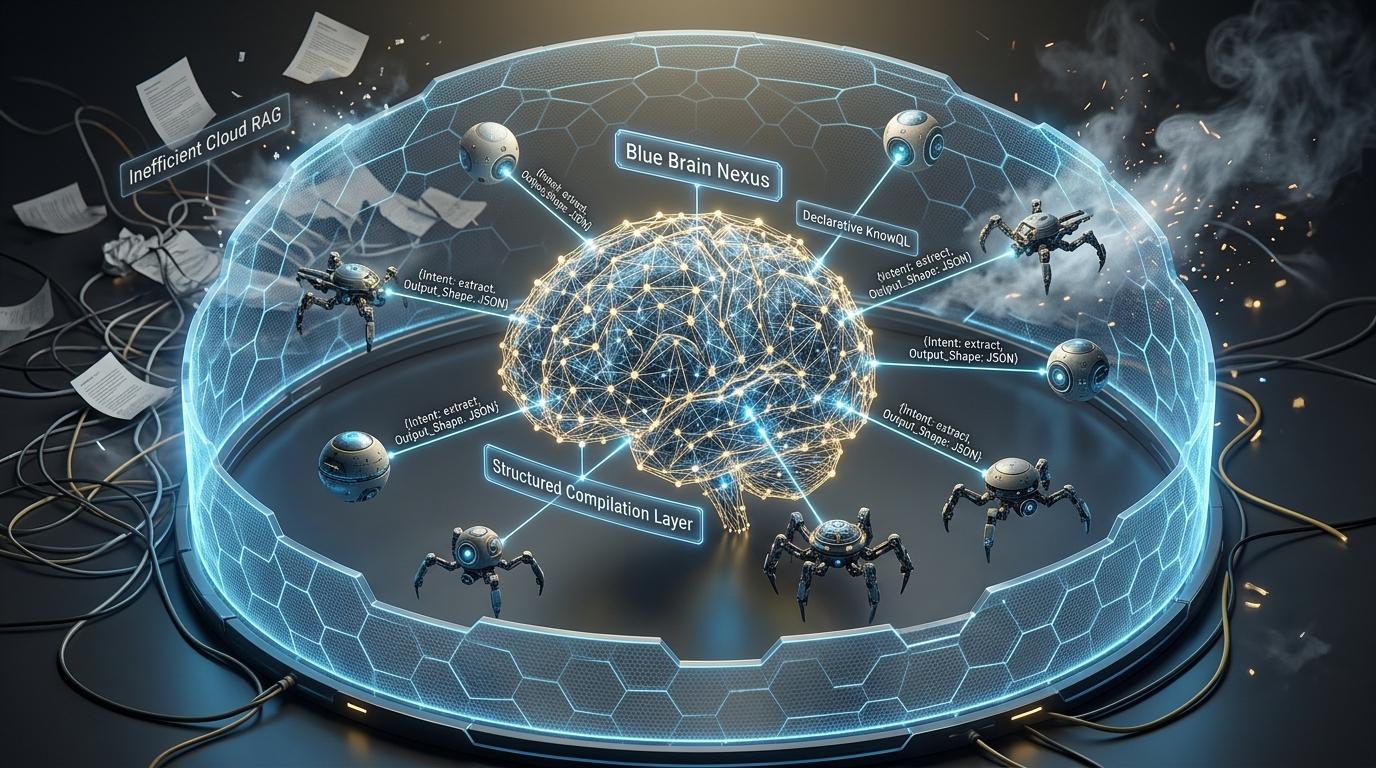
Traditional RAG is failing autonomous agents. Learn how to bypass proprietary SaaS lock-in by engineering a deterministic, graph-based knowledge engine using Blue Brain Nexus and custom declarative queries.
The Era of Post-RAG Architecture
The AI infrastructure world recently had a massive wake-up call. When Pinecone, the company that practically defined the modern vector database, released Pinecone Nexus, they quietly admitted what many seasoned engineers already knew: Traditional RAG is broken for autonomous agents. Dumping raw, unstructured text into an LLM context window at inference time burns massive amounts of tokens, spikes latency, and invites hallucinations. Pinecone proposed a managed Knowledge Engine using a declarative query language called KnowQL. But for the enterprise, renting an agent brain via a SaaS API is not just a dependency issue; it is a security risk.
The Foundation: Why Blue Brain Nexus?
To outcompete managed systems, you cannot rely on a flat vector database. You need a graph. Blue Brain Nexus (BBN) is an open-source, enterprise-grade data management platform that enforces strict structural integrity. While vector databases understand similarity, BBN understands relationships through a dual-engine approach.
- SPARQL: Enables deterministic, multi-hop relationship traversal. If your agent needs to identify which microservices depend on a specific API, SPARQL returns a factual list rather than a fuzzy semantic approximation.
- Elasticsearch Integration: BBN pairs its graph capabilities with Elasticsearch, allowing you to filter massive volumes of text to remove noise before executing complex traversals.
Designing Your Custom KnowQL Interface
Agents should not rely on unpredictable prompt engineering to retrieve data. You need a strict contract between your swarm and your database. By defining a Pydantic-backed schema, you can enforce the 6 Core Primitives of autonomous retrieval:
- Intent: The factual requirement.
- Filter: RBAC-based node visibility.
- Budget: Latency and compute hard limits.
- Confidence: The minimum certainty threshold.
- Provenance: Field-level citations via @id URIs.
- Output Shape: A strict JSON schema for the response.
When an agent requires data, it passes a deterministic payload rather than a natural language query:
{
  "query_spec": {
    "intent": "Find all microservices dependent on Auth Service v2",
    "filter": { "role_clearance": "system_architect" },
    "budget": { "max_latency_ms": 800 },
    "confidence": { "min_threshold": 0.95 },
    "output_shape": {
      "service_name": "string",
      "repository_url": "string"
    }
  }
}
The Compiler: Translation and MCP Integration
BBN does not speak your custom JSON schema natively; it speaks SPARQL. You must build a middleware compiler. This lightweight layer intercepts the agent payload, translates the intent into a multi-hop SPARQL query, executes it against BBN, and maps the RDF graph data into the requested JSON output shape.
To achieve true scalability, wrap this logic in a Model Context Protocol (MCP) server. This makes your retrieval engine universally accessible. Any agent within your swarm can plug into this MCP server and speak your custom KnowQL, regardless of the underlying LLM.
Zero Waste, Total Sovereignty
By moving to this architecture, you move away from messy RAG. The agent is never forced to parse sprawling PDFs. Instead, it receives a clean, structured map of exact relationships. The trade-offs are clear: building this on Blue Brain Nexus requires significant upfront engineering compared to a managed SaaS solution. However, the benefits are transformative:
- Near-Zero Token Waste: Agents receive only the exact data points required.
- Immunity to Context Loss: You bypass the lost in the middle problem by passing arrays instead of raw text.
- Absolute Sovereignty: The entire stack remains behind your firewall. No proprietary data leaks to external APIs.
- Flat Unit Economics: You pay for infrastructure, not per-token usage.
If you want to build toy agents, stick to standard RAG. If you want to build autonomous enterprise systems, it is time to start compiling your knowledge graph.